APPLIED AI PORTFOLIO
AI systems I’ve built and led
My work spans production GenAI in banking, predictive machine learning at a startup, and a synthetic-data POC in insurance. These examples explain my contribution, the engineering decisions, and the scope of the results.
Production — deployed systems · Completed POC — prototype work · Reference pattern — an architectural illustration
Selected AI case studies
EverBank: GenAI · PurePredictive: ML · The Hartford: synthetic data
PRODUCTION · EVERBANK
Taking GenAI into production in banking
The bank needed usable GenAI applications with the controls expected in a regulated environment.
My contribution
As Chief Data Officer, I led a 50-person global data and AI organization and delivered the bank’s first two production GenAI/RAG applications. I also chaired AI Governance with Legal, Information Security, Risk, and Compliance.
Architecture decisions
We used Snowflake Cortex Search and Cortex Analyst, with confidence scoring, structured output validation, role-based access, and audit controls. I evaluated LangChain, LlamaIndex, Hugging Face, FAISS, and vLLM in isolated environments to inform technology choices.
Validation and controls
Output validation, confidence scoring, access restrictions, and auditability were part of the production approach. Governance work established risk classification and production approval criteria.
Delivered
Two production GenAI applications, supported by engineering controls and cross-functional governance.


Simplified illustration of the documented work; not an internal system blueprint.
PRODUCTION · PUREPREDICTIVE
Operating machine learning as a product capability
Business applications needed dependable prediction services, supported by repeatable model deployment and ongoing monitoring.
My contribution
As co-founder and CTO, I led engineering, data science, and platform architecture, including a distributed team of 16 engineers. We built infrastructure supporting more than 250 production ML models.
Architecture decisions
The platform combined model validation, deployment, drift monitoring, and retraining capabilities with tenant isolation and application performance requirements.
Validation and operation
Automated validation and drift monitoring supported model operation, with retraining triggers to address changing data and model behavior.
Delivered
Infrastructure supporting 250+ production ML models. This work also connects to my granted patent for native machine learning integration in a data management product.

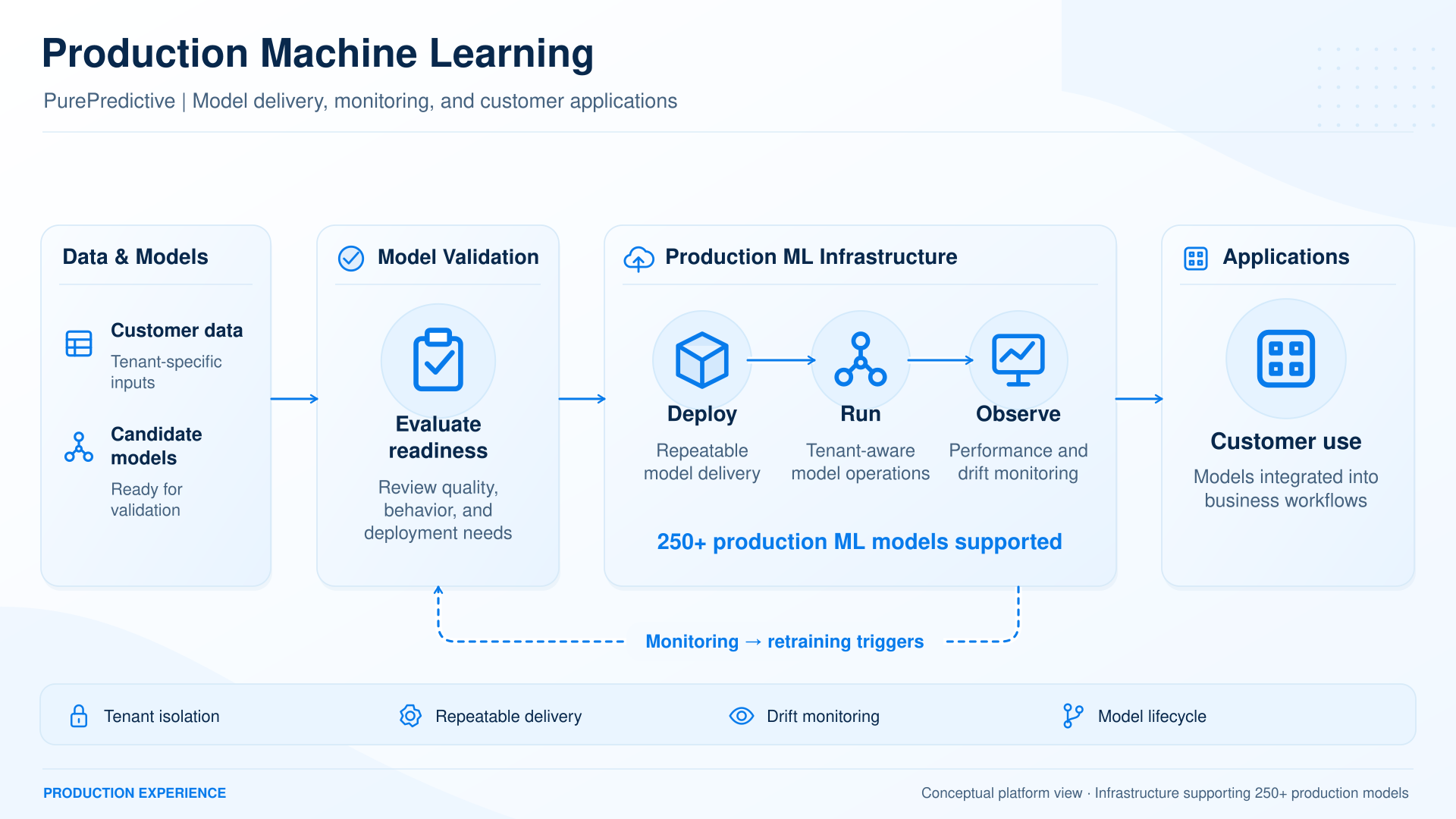
Simplified illustration of the documented work; not an internal system blueprint.
COMPLETED POC · THE HARTFORD
Exploring synthetic data for development and testing
Engineering teams needed realistic test data while limiting exposure of production personally identifiable information.
My contribution
I prototyped synthetic-data generation using open-source LLMs and statistical modeling to create development and test datasets.
Technical approach
The POC explored how language models and statistical methods could support realistic test-data generation. The diagram separates the generation approaches and shows the resulting data flowing into development and testing.
POC scope
Development and test data generation, with the goal of reducing exposure of production PII.
Delivered
A completed synthetic-data POC. The review criteria in the diagram are illustrative design considerations, not measured privacy or model-quality results.

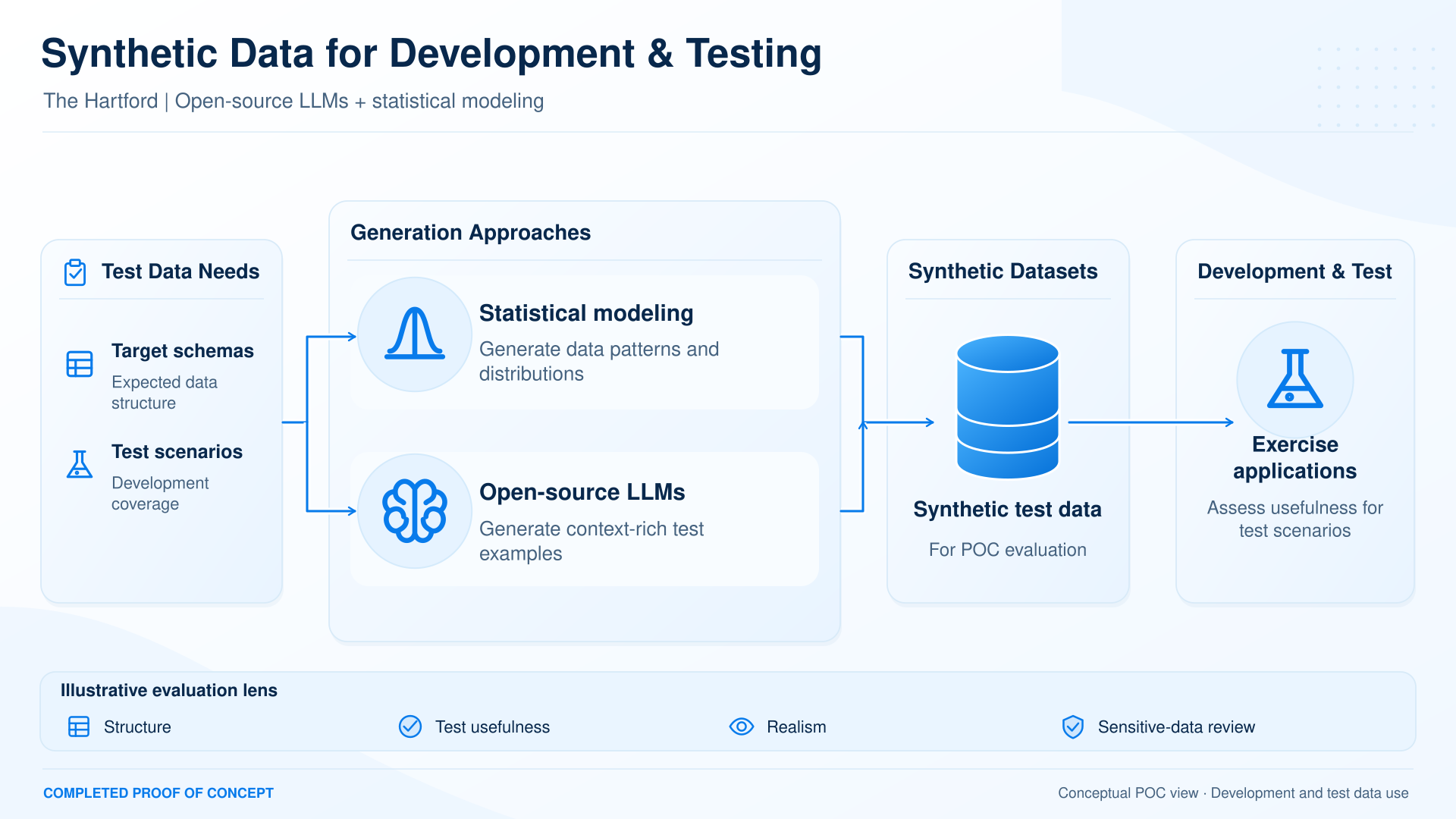
Simplified illustration of the documented work; not an internal system blueprint.
ENGINEERING FOUNDATIONS
The architecture that supports applied AI
These reference patterns draw on my platform and governance work. The results below belong to the named initiatives; the diagrams are simplified illustrations.
REFERENCE PATTERN
AI governance in practice

At EverBank, I chaired AI Governance and helped define policies, risk classification, and production approval criteria. This reference pattern shows how those decisions connect to engineering controls and operational review.
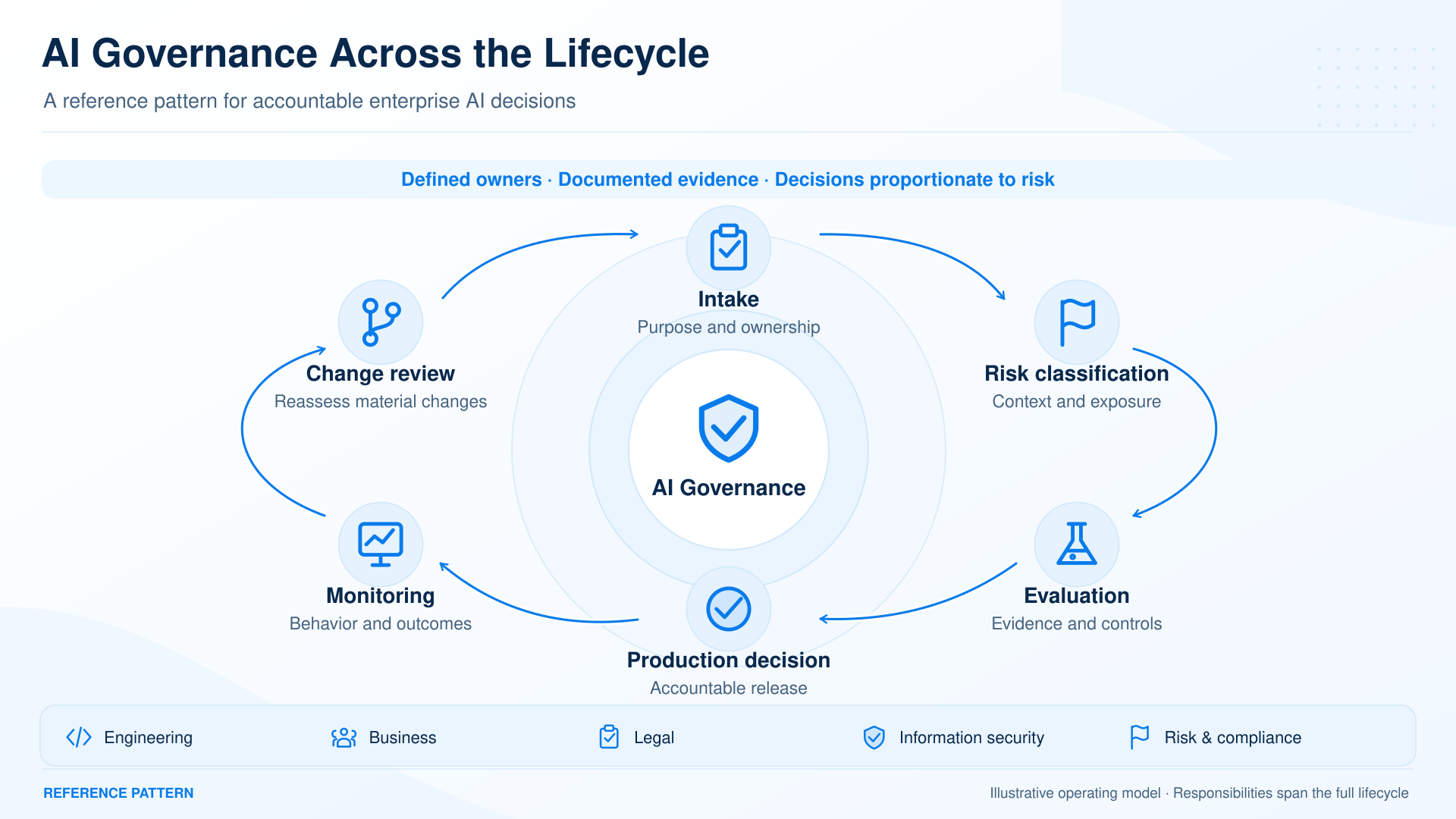
REFERENCE PATTERN
Governed data foundations

AI depends on usable, trustworthy data. At The Hartford, my work included quality controls across 50+ sources and an 85% reduction in production incidents. This diagram illustrates the platform layers and controls that support AI consumption.

REFERENCE PATTERN
Event-driven data delivery

At AvantLink, I built a streaming platform handling 10M+ daily events with Kinesis and DynamoDB and reduced refresh time from six hours to 15 minutes. In a separate Hartford initiative, synchronization fell from 24 hours to about 30 minutes. The diagram presents a general streaming pattern.

REFERENCE PATTERN
Metadata-driven engineering

At The Hartford, the M81 metadata-driven framework reduced custom development effort by 40% and accelerated delivery by 25%. This pattern shows how configuration, reusable templates, validation, and CI/CD support repeatable engineering.

Building an AI capability?
I work across AI engineering leadership, enterprise architecture, and advisory engagements.
Start a conversation